
Sultan Abdul Samad Building
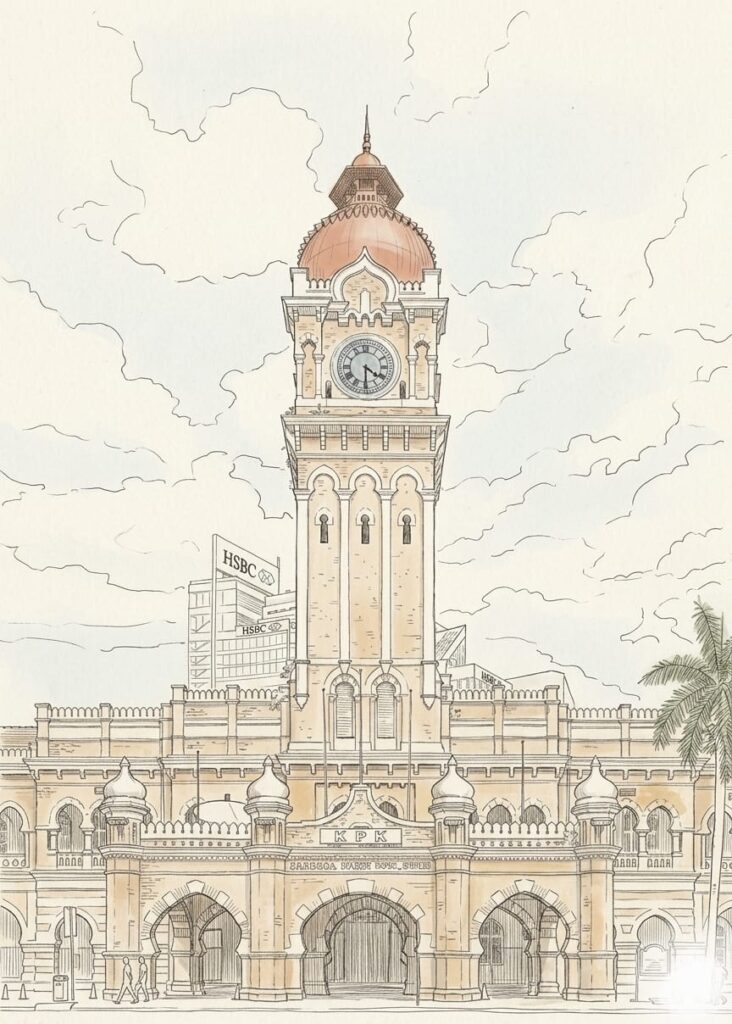
The Sultan Abdul Samad Building is a landmark colonial-era structure in Kuala Lumpur, Malaysia, renowned for its Indo-Saracenic architecture. Completed in 1897, it originally housed British administrative offices and now stands as a key symbol of Malaysia’s legal and historical heritage along Merdeka Square.
Key facts
- Location: Jalan Raja, Kuala Lumpur, Malaysia
- Completed: 1897
- Architects: A.C. Norman, R.A.J. Bidwell, and A.B. Hubback
- Architectural style: Indo-Saracenic / Neo-Mughal
- Current use: Government offices and national heritage site
History and construction
Commissioned by the British colonial government, the building was designed to centralize administrative departments such as the Secretariat and the Supreme Court. Its name honors Sultan Abdul Samad, the then-ruler of Selangor. The structure marked one of the earliest major uses of brick in Kuala Lumpur, replacing a cluster of wooden government offices.
Architectural features
The building’s distinctive design combines Moorish, Islamic, and Victorian influences, showcasing domed copper cupolas, horseshoe arches, and an elegant 41-meter clock tower. The symmetrical façade and colonnaded verandas highlight both aesthetic and climatic considerations, providing shade and ventilation suitable for tropical conditions.
Cultural and civic significance
Located opposite Merdeka Square, where Malaysia’s independence was proclaimed in 1957, the Sultan Abdul Samad Building has become a national icon. It frequently serves as a ceremonial backdrop for parades and celebrations such as National Day. Its illuminated façade at night underscores its continuing role as a visual focal point of the city.
Preservation and current use
After Malaysia’s independence, the building continued as a seat for the superior courts until 2007, when they relocated to Putrajaya. It has since been restored and designated as a heritage structure, housing the Ministry of Communications and Multimedia and the Ministry of Tourism, Arts, and Culture.