Ateshgah (Fire Temple)
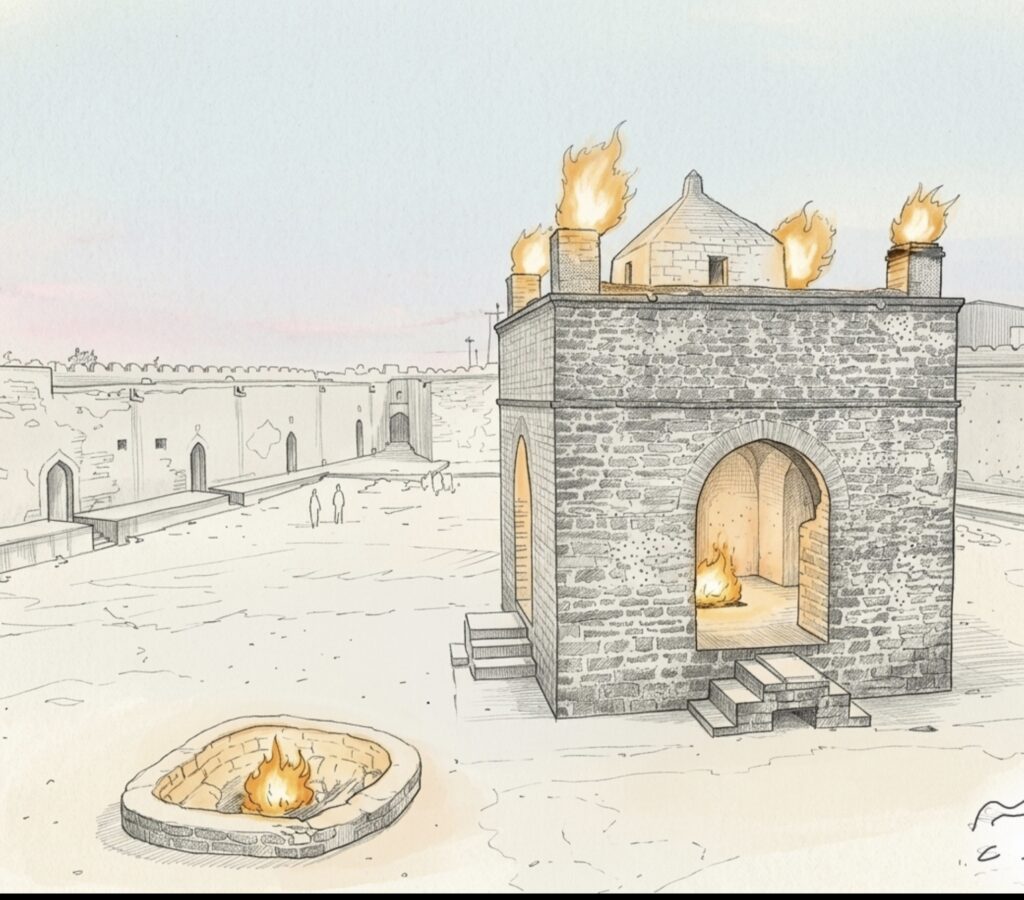
The Ateshgah of Baku (often simply called the Ateshgah Fire Temple) is one of Azerbaijan’s most fascinating and enigmatic historical landmarks. Located in Surakhani, a suburb of Baku on the Absheron Peninsula, this castle-like religious complex stands as a testament to the country’s ancient moniker: Odlar Yurdu (The Land of Fire).
A Crossroad of Faiths
While the historical roots of fire worship on the Absheron Peninsula trace back millennia to ancient Zoroastrianism, the structure standing today was built during the 17th and 18th centuries.
What makes Ateshgah truly unique is its syncretic (faith-blending) history. As trade flourished along the Grand Trunk Road and Silk Road networks, merchants and ascetics from the Indian subcontinent traveled through Baku. The temple became a shared sacred space for:
Zoroastrians, who revere fire as a pure connection to the divine.
Hindus, who dedicated shrines to Lord Shiva and Lord Ganesha.
Sikhs, who left behind sacred inscriptions honoring their Gurus.
Architectural Highlights
The temple’s layout resembles a fortified caravanserai (a traditional roadside inn for traders), designed both for spiritual isolation and protection.
The Pentagonal Complex: A fortress-like outer wall with battlements encloses a central, open-air courtyard.
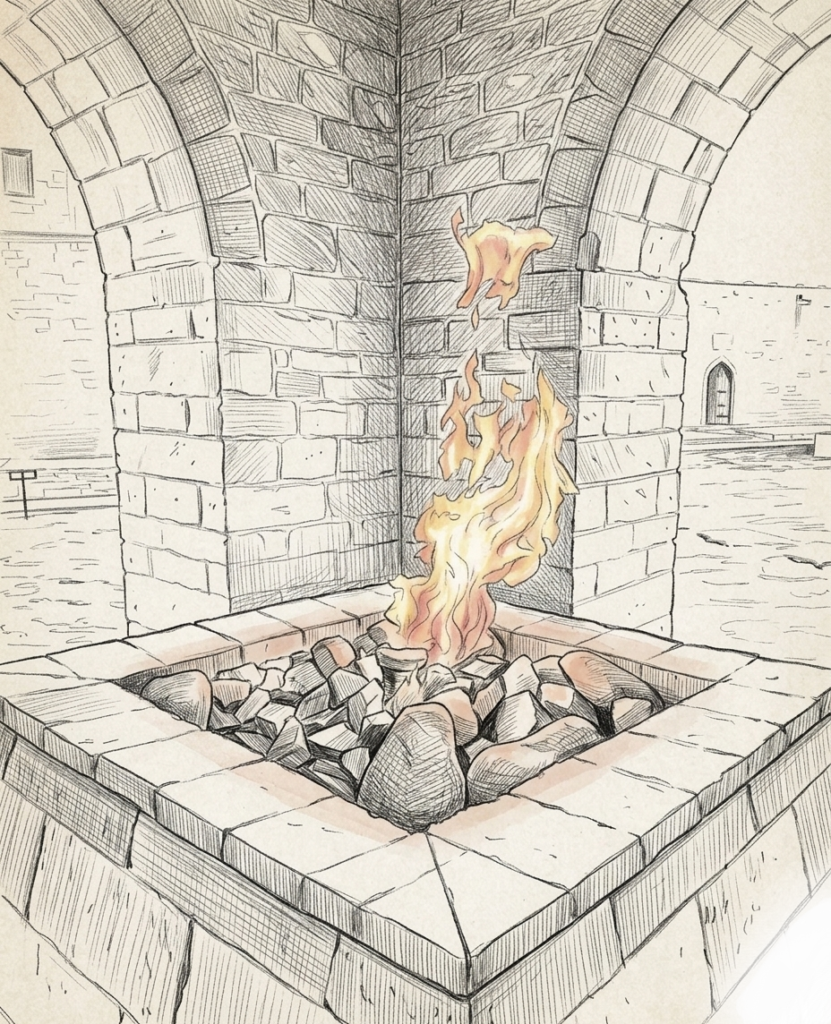
The Tetrapillar Altar: At the absolute center of the courtyard sits a stone gazebo-style altar (chahar-taq). This altar was historically built directly over a natural gas vent where natural gas escaped, igniting on contact with oxygen to create a dramatic “eternal flame.”
The Ascetic Cells: Lined along the interior walls are 24 small, austere cells (hücrə). These served as living and meditation quarters for the resident monks, who practiced extreme asceticism, often sleeping on bare stone platforms.
Ancient Inscriptions: Above many of the cell doorways, you can still find well-preserved stone plaques featuring carvings in Sanskrit, Gurmukhi, and Persian. A prominent Hindu inscription begins with a salute to Lord Ganesha, while a rooftop trident (Trishul) crowns the structure.
From Sacred Site to State Museum
By the mid-19th century, the intense commercial exploitation of Baku’s massive oil and gas reserves shifted the landscape. The heavy drilling surrounding the area disrupted the underground pressure, causing the natural gas to seek other outlets. In 1883, the last Indian priest left the site, and the temple was abandoned.
The original natural flame finally sputtered out completely in 1969. Recognizing its deep historical value, the complex was converted into a museum in 1975, and in 2007, it was declared a State Historical-Architectural Reserve. Today, the central flame burns brightly once more—safely sustained by Baku’s modern gas pipeline system—welcoming travelers from all over the world to marvel at its mysterious, cross-cultural heritage.